Wednesday, May 21, 2014

The Finger Lakes, NY: Lake Seneca Viticulture and Vinification

The Finger Lakes, New York State
Lake Seneca Viticulture and Vinification

A view looking south over Lake Seneca, the deepest lake in New York at 617', from Long Pier in Geneva, NY.

The Finger Lakes in NY is a cool-climate agricultural region that has historically been the home to many vitis labrusca grape varieties like Catawba and our adored Concord grape.  The first commercial winery in the Finger Lakes was established in 1863 making sacramental wines from these and other native grape varieties.


Vines wrapped around a trellis, left after winter pruning at the Boundary Breaks vineyard.

Serious wine making can be attributed to Dr. Konstantine Frank, an agriculture Ph.D. who came to the US from Europe to teach at Cornell University in 1951.  The introduction of European grape varieties, an academic approach to grape growing and the development of vine grafting have been major factors in the premium wine industry of the Finger Lakes.  Wineries like Hermann J. Wiemer are on the cutting edge of viticultural research.  One of Wiemer's vineyards is dedicated to the production of vine scions and research of more than 60 different Riesling clones from German and French vineyards.

The geography of the Finger Lakes creates many microclimates, suitable for different grapes and styles of wine.  Lake Seneca is the deepest lake in NY state.  At 617' deep, it doesn't freeze in the winter despite upstate NY having some of the most snow and coldest temperatures in the continental US.  During the growing season, this keeps the vines cool in hot days and warm during the cool nights.  The lake effect also creates strong breezes to help dry off clusters of grapes which are very prone to botrytis cinerea (aka bunch rot or grey mold).

Looking down from the east bank of Lake Seneca.

The major factors affecting terrior in the vineyards of the Finger Lakes are depth of the lake, proximity to the water, slope and aspect.  The depth of the lake determines the intensity of the lake effect.  Depending on the proximity to the water, the temperature regulation and the breeze created by the lake are realized at different levels.  Combined, the depth of the lake and proximity to the water create VERY diverse micro-climates, even in relation to a single lake.


The slope of the vineyards and their aspect can have major affects on the drainage and sun exposure for vines.  Depending on where a vine is on the lake, and what direction it is facing, different vine training systems are used to either maximize sun exposure, or shield grapes and/or to allow good air circulation.  Many vine rows are planted parallel with the lake to maximize sun exposure, in which case the plant's leaf canopy is trained over the western side of the row and is thinned from the eastern side .  This allows the morning sun to directly contact the grapes and dry off the night's dew to prevent botrytis and ripen the grapes.

Some vineyards are located along parts of the lake that allow thier vineyard managers to plant the vine rows perpendicular to the lake, so that there is greater air circulation between the vines.  This allows the grapes to dry off without sun, so they can stay on the vines for additional time.  This allows for more phenolic ripeness and possibly higher sugar levels if there isn't rain right before harvest.

Young vines being being pruned in the Scott-Henry vine trellis system.

The fruit-first mentality of many Finger Lakes winemakers benefits from a low-intervention style of wine making.  Although there are many different levels of wine quality coming from the region, the best winemakers do not practice any sort of wine "doctoring" like chaptalization (adding sugar to increase the potential alcohol) or acidification.  Some winemakers, like Hermann J Wiemer don't inoculate their wines, and allow fermentation to happen naturally from wild yeast.  Depending on the harvest date, the warmer ambient temperature for earlier harvests can help to kick start the fermentation process.  Contrarily, the cooler ambient temperature for later harvests may sometimes delay the fermentation process, sometimes leaving the juice to age and develop all winter until fermentation takes off with the arrival of warmer spring temperatures the follow year.

Hermann J. Wiemer's current release 2012 Reserve Riesling.  Many of the plots that went into this reserve wine were harvested at later dates, and didn't start fermentation until the follow spring.
Many of the premium wines coming from the Finger Lakes are dominated by Riesling, but excellent quality Cabernet Franc and Chardonnay based sparkling wines are being produced.

The tasting room at Hermann Wiemer is in the same renovated barn were they make the wines.
The calcitic soils that are a continuation of the Niagara escarpment line many of the roads as you drive around the Finger Lakes.  These cliffs are carved out in many spots creating beautiful waterfalls between vineyard sites.


Thursday, October 25, 2012

Starch and Gluten 101: The composition and behavior of wheat flour

Often times as a cook, wheat flour has remained on of those elusive ingredients, the understanding of which is left to depraved genius bakers and pastry chefs.  They live in an elevated state, at least in my mind.


What is it though that makes flour so temperamental?

After a horrific failed attempt at making hand pulled noodles, this question was eating me alive, so I had to do a little research.  What are the major chemical components of flour, and what are their roles in its behavior?

Flour is one of nature’s incredible storage machines.  In it’s natural state, it is composed of starches and proteins, along with vitamins and other nutrients.

So what is starch?  Starch is an incredible complex carbohydrate (a polysaccharide) that is found in all plants to store as much glucose (one of three natural simple sugars, or monosaccharide) as possible in a compact granule.  Glucose by itself loves water (it is hydrophilic).  So, to maximize storage potential when glucose is bonded together into starch granules it is not water soluble in cold water (it becomes hydrophobic).

When starch is added to warm water, however, the magic starts to happen.  Starch is composed of two smaller polysaccharides, about 20-30% amylose and 70-80% amylopectin.  Amylose is hydrophobic and bonds with itself and other molecules in flour, acting as a gelling agent.  Its partner, amylopectin is hydrophillic and acts as a thickening or stabilizing agent. Amylopectin provides more pliability (think Play-Doh), while amylose provides more structure or spring-back (think Jello).  As these two components of starch break down and restructure themselves into a slurry of gel and paste the magical process is called retrogradation.

As this retrograded starch starts to cool off, a process called syneresis occurs in which water is expelled causing separation of the thickened gel/paste and water.  You see an example syneresis in everyday life as a layer of water forms on top of yogurt or sour cream.  This process is also partially to blame for bread becoming stale.

The other important component of wheat flour is protein.  The average protein content of grain is 10-18% and of this protein, 80% is gluten.  Gluten, much like starch, is a storage molecule but in this case it provides storage of amino acids.  There are two primary structures that compose gluten: gliadin and glutelin.  These structures are called prolamines and are essentially large amounts of amino acids that are bonded together into one molecule.

The most important role of gluten in bread is the elasticity it allows during the baking process, allowing bread to rise.  Now, here is where some of my confusion originated when attempting to make hand pulled noodles.  When I say gluten elasticity, do not think rubber band elasticity.  Think blowing soap bubbles elasticity.  Try to pull soap water into a noodle shape.  I promise that you will become very frustrated and punch your ball of dough in exasperation, just to see it bounce back to it’s original shape and not even give you the gratification of leaving the indent of your fist.


Here is chart to give you an idea of what happens to your bread with different levels of gluten and starch:

Composition
Flour type
Protein content
Examples
High Gluten
(High elasticity)


High Starch
(Crumbly)
Gluten Flour
45%
Bagels, challah, pizza dough, pullman loaf


Pie crust, cake, filo dough, short bread
High-gluten
14-15%
Bread Flour
12.5-14%
AP Flour
10-12%
Pastry Flour
~9-10%
Cake Flour
7-9

Sunday, October 7, 2012

The Science Behind Kimchi


My attempts at making homemade kimchi have led to an interesting question: how long can it be aged, and why?


The origin of fermented food was dependent upon a few key factors: nutritional value and shelf life.  Kimchi itself is from Korea and comes in hundreds of styles.  It is categorized in several ways, of which there are a few important designations: base produce (ie. cabbage, radish, cucumber), season (ie. winter kimchi, summer kimchi) and region (ie. northern Korea, southern Korea).


To maximize the value and flavor of kimchi it is necessary to understand some of the contributing factors that determine how kimchi is preserved and at what point it becomes inedible.  Within a batch of kimchi, a unique environment is created based on the acidity, pH level, sodium level and temperature.  This environment creates a very restrictive ecosystem, which is preferred by Lactic Acid Bacteria (LAB). In the case of kimchi the primary bacteria family is Lactobacilius, a bacteria already present in the human digestive system.  A single batch of kimchi may have hundreds of different strains of LAB, each contributing certain characteristics to their environment, but most importantly producing lactic acid, which is the main preservation agent.

So what happens when kimchi is made?  Each of the unique ingredients which make up kimchi have important roles: salt regulates the speed of fermentation, sugar and starch provide the food for the bacteria to consume, the base produce provides the body of the kimchi, the ginger and garlic provide nutrition and antibacterial qualities that regulate the freshness and fermentation of the mix.  Each of these also carries their own set of ambient yeasts and bacteria.

The warmer the storage temperature, the faster the metabolism of the bacteria and the faster the fermentation takes place.  The best results are achieved when the bacteria begins to ferment the kimchi quickly, but are then transferred to conditions that allow for the slowest ripening.  This allows less time for other, less desirable bacteria, to affect the quality and flavor of the kimchi.  There have been studies on using sherry yeast or a starter from previous batch of cold fermented kimchi (41*F) to jump start fermentation, much like a sourdough bread starter.

The initial fermentation of kimchi takes place between hetero LAB strains.  These strains of bacteria primarily produce organic acids and carbon dioxide as byproducts.  After the first fermentation, the flavor profile is at its peak, with a target pH level of 4.2-4.5 and an acidity level of 0.6-0.8% (http://cms.daegu.ac.kr/sgpark/microbiology/김치발효젖산균.pdf).  To maximize shelf life, the goal is to quickly bring the kimchi through this first fermentation and maintain the pH and acidity levels by monitoring temperature and having the right balance of salt and antiseptic/ antibacterial ingredients (ginger, garlic and optional green tea).

As kimchi ages, the pH slowly drops and the acidity level rises, this change happens quickly when the kimchi reaches its second fermentation between homo LAB strains.  These strains of bacteria produce excessive amounts of lactic acid.  This fermentation brings the kimchi out of the desired pH and acidity levels and closer to inedible acidity levels, introducing less desirable flavor profiles.  So, ideally kimchi goes quickly through its first fermentation and is then introduced to an environment that delays the secondary fermentation as long as possible.

If prepared and stored properly, a batch of kimchi may remain edible for as many as 3 years, although at this point it is well beyond the target flavor profile, pH and acidity levels.  All that’s left to do is make a hot and sour kimchi soup.  Let's take a quick look at the perfect environment for a batch of extended shelf-life kimchi.

First we need a very even and accurate level of sodium to initially dehydrate the base produce.  Applying granulated salt by hand tends to be less accurate, so a different technique serves very well.  A 15% saltwater brine (a ratio of 1:5 salt to water) provides even distribution and an accurate level of salt.  A batch of kimchi begins with a 6-hour brine.

After the ingredients have been put together and the kimchi is put in jars, preferably with a starter from a previous batch of cold fermented kimchi (41*F), the kimchi needs to spend less than 18hours in a cool (60*F), dark place and then be moved to the refrigerator.  This will allow the slow fermenting hetero LAB strains to get a head start without over acidifying the kimchi and then move into a cold environment that will allow the fermentation process to slow down and delay the second fermentation.

This is what you need to make Kimchi:

Equipment:
3 Large mixing bowls
Rubber Gloves
2 two-quart jars

Ingredients:
Raw Ingredients:
2 Napa Cabbages
1 Korean Radish
¼ c. Green Onion
Brine:
                        5 c. Salt
30 c. Water
Kimchi Paste:
1 c. Sweet Rice Flour (Tobiko)
3 c. Water
½ c. Sugar
1 tbs. Fish Sauce (I'll make this myself sometime soon)
1-3 c. Red Pepper Powder (grind yourself if you're up to it)
1 Large Onion
1 c. Garlic
3 tbsp. Ginger
Optional Additions:
1 c. Raw Oysters
1 c. Dried Shrimp
1 tbsp. Matcha green tea powder

First, create a 15% (1:5) salt-water brine by combining your salt and water and stir until completely dissolved.  Halve your napa cabbage through the heart and chop your radish into 1" cubes and rinse, retaining 1/5 of uncubed radish for the paste.  Separate the cabbage and radish into separate bowls.  Pour enough brine over the cabbage and radish to cover and let them sit for 6 hours, stirring once.  When this is complete, rinse the radish and cabbage thoroughly between each leaf at least 3 times and strain to dry.


Meanwhile, begin your kimchi paste: add your sweet rice flour and water to a small saucepan until fully dissolved.  Add the sugar and stir until the mixture just begins to bubble.  Transfer mixture to a large mixing bowl.


In a food processor, combine garlic, ginger and onion and process into a paste.  Add to flour mixture with fish sauce, red pepper powder, green tea powder, chopped green onions and the rest of the julienned radish.

At this point you may add your optional seafood.


Mix the kimchi paste ingredients together and you are ready to start putting your kimchi together.  It is advisable to use some gloves for this step.  With your hands, apply the kimchi paste in between each of the leaves of the cabbage and on the outside.  Squeeze out any excess paste and you are ready to bottle your cabbage kimchi.  Add the radish to the remainder of the paste, stir and this is ready to bottle as well.

Friday, September 21, 2012

Empanadas Chilenas

To celebrate Chile's Independence Day I made a classic holiday food: empanadas.

There are a few variations on Chilean empanadas, most importantly wether they are baked (al horno) or fried (fritas).  The other important variations are the fillings.  The most common are Empanadas de Pino, made with ground beef, hard boiled eggs, black olives and golden raisins.  You can also fill the empanadas with cheese or "a la Napolitana" with cheese, prosciutto and basil.

The following is the recipe for Empanadas de Pino al Horno: (makes approx. 12 large empanadas)


First, prepare the accoutrements:

Hard boil 3 eggs.  I recommend the following method.  Place the eggs in cold water and bring to a boil.  When the water reaches a hard boil, remove from the heat and let rest in the hot water for 8 minutes.  Transfer to an ice bath for a few minutes, then peel.  These will be cut into quarters.

Drain and rinse extra large black olives.

Soak the golden raisins.  I have been soaking the raisins in Chilean Sauvignon Blanc, it adds a nice touch of acid to the raisins (and gives you a reason to finish the bottle as you prepare the rest of the empanadas).


Then, it is essential to prepare a good dough (masa).

4 c. AP flour
1 tsp. baking powder
1/2 c. melted lard
1/2 c. clarified butter
3/4 c. warm water
1 tbsp. salt

Sift the flour, baking powder and salt together into a mound on a table top and form a volcano to contain the liquid ingredients.  Add the lard and butter and start to whisk the ingredients together from the inside to avoid the liquid escaping.  Knead the dough JUST until it is fully incorporated.  Over kneading will make the dough too tough.  When finished, place in a bowl, cover with a damp cloth and allow to sit for 45 minutes.

While the dough is resting, prepare the pino.

1 1/2 lbs. 85/15 ground beef
1 large onion
4 tbsp vegetable oil
3 tbsp ground cumin
2 tbsp salt
1 tsp granulated white sugar
1 tbsp freshly ground black pepper

Chop the onions and sauté with 1 1/2 tbsp oil on medium heat until they are nicely browned.  Remove onions from the pan to be added to the pino.  Heat a clean pan over high heat and add oil when HOT.  The pan should almost be at smoke point when you add the oil.  Add the ground beef, cumin, salt and pepper.  Lower heat to medium-high.  Stir until well browned and add the the browned onions.  Lower heat to a simmer to allow flavors to marry.  Do not be afraid to well season the Pino.

Now it's time to roll the empanadas.

Remove the dough from the bowl and cut into two pieces.  Roll each half out into a log and cut into 6 sections.  Roll each piece into a ball and then flatten into a circle.  Into each flattened circle add a 1/4 of a hard boiled egg, an olive, about 10 raisins and 2 well rounded tablespoons of pino to the top half of the dough.  Brush the edges of the dough with an egg wash, fold and pinch the bottom layer over the top layer every 1/2 inch all the way around the edge.

Lay the finished empanadas on a baking sheet dusted with flour and brush the tops with an egg wash, and bake at 375ºF until golden brown.


Thursday, November 10, 2011

Homemade Gingerale

In the spirit of the season... This is one component of a cocktail I am working on:

Homemade Gingerale:
1 c. cane sugar
2 tbsp peeled and grated ginger root
1/4 tsp. dry yeast
1 lime, juiced
cold filtered water


Combine the dry ingredients in a PLASTIC 2 liter bottle (make sure to use plastic so you can manually monitor the pressure in the bottle).  Add the wet ingredients and fill bottle to a little below the neck.


Leave the finished product at room temperature for 24-48 hours and monitor pressure occasionally.  When the bottle is firm, release the pressure and refrigerate.

I need to do some experimentation with the best way to filter my ginger ale.  I will keep you updated.

5/8/14 UPDATE:  This experiment was fun.  I learned a couple things though.  Depending on the ambient temperature when the initial fermentation begins, your bottle may keep fermenting for a while.  Opening the bottle too early resulted in a very volatile and messy experience.  The product after a few days had a pretty profound yeasty, raw dough flavor which I disliked.  I closed the cap and left the ginger ale in my fridge for another week (meaning I gave up on it).  When I retried the ginger ale after that week all the yeast had died and the flavor dissipated.  The finished product was decently carbonated and pretty delicious.  My only complaint was the lime juice didn't taste fresh.  In future batches I think I will omit the lime juice and add it as an additive/ garnish when served.


Saturday, June 11, 2011

Chablis Training Seminar Highlights - June 8th

Recently I had the opportunity to attend a Chablis Training Seminar produced by the Burgundy Wine Board.  The highlights of the seminar were the discussion of Chablis as one of the most iconic white wines in the world and the associated high demand and fraud; the 'climats' of the Grand Cru appellation; and the incredible diversity of vinification styles within Chablis.

Look at this map: Chablis.


<Climats> of the One-and-Only Grand Cru Appellation

That's right, there is only one Grand Cru appellation in Chablis.  So why are there names listed on the bottle after the Grand Cru AOC?  Within the vineyard there are seven different 'climats,' separated by elevation, slope and degree of south-facing sun exposure: Blanchot, Bougros, Les Clos, Grenouilles, Preuses, Valmur, Vaudésir.

The wines we tasted are as follows:

1. Petit Chablis, 2009, La Chablisienne  Clean, zippy lemon-lime juice and bitey, green apple tang with very slight vegetal and musty undertones. (Suggested Pairing: cheese puffs)

2. Chablis, 2009, Domaine Daniel DAMPT et Fils  Slightly more developed fruit, leaning towards the floral, sweet pear, green apple and vanilla qualities.

3. Chablis, 2009, Domaine des Malandes Sweet, aromatic lemon oil dances upon a seashell minerality with with an essence of delicate, toasty, grilled green asparagus.

4. Chablis 1er Cru, Montmains, 2009, Domaine VOCORET et Fils  This wine exhibited some of the vinification styles that are less expected from a Chablis.  Definite toast and butter notes with a lemony, stone fruit core.  With this wine, the ability to pair with creamy seafood really started to  jump up and down. (Suggested pairing: offal/ headcheese and thicker butter sauces)

5. Chablis 1er Cru, Mont de Milieu, 2009, Domaine SIMMONET-FEBVRE  Although it has the same structure of the Chablis and Petit Chablis, the fruit really changed on this one.  The fruit became much softer and really balanced the acidity.  White peaches and floral notes sang on the nose, and dissolved on the palate.

6. Chablis 1er Cru, Vaillons, 2008, Domaine du Chardonnay  This was the most interesting wine in the flight.  It was pure olive or oyster brine.  The fruit was yellow, both apples and pears.  The culprit?  Bâtonnage.  The stirring of the lees left some warm brioche to suck up the sauce.

7. Chablis Grand Cru, Bougros, 2008, William FEVRE  This one was corked.  I would like to personally re-taste this Grand Cru, and I think I've seen it in the local wineshops.  Strong minerality and sweet vanilla notes persisted on the nose.

These were all pre-opened and were approaching room temp.  However the final Grand Cru was opened about 20 minutes before we tasted it and really showed some interesting characteristics from bottle aging.

8. Chablis Grand Cru, Grenouilles, 2005, La Chablisienne  I was a little overwhelmed with this one. It was definitely was tacked onto the uncommon delights list.  Previously, I have predominantly tasted older white wines of the Champagne and Riesling regions.  A true Chablis Grand Cru with some age on it morphs into some interesting pantry (or maybe special order) items: lanolin, beeswax and toffee soaking into the juicy bruised pineapple.


Wednesday, June 8, 2011

2006 Castello di Gabbiano Chianti Classico Riserva DOCeG

2006 Castello di Gabbiano Chianti Classico Riserva DOCeG


I have been craving pasta in a light tomato sauce all week. Along with this craving has come the desire for a good Sangiovese.  Well, tonight I am eating pasta... Pasta fagioli with pork belly, kale in a tomato sauce. Thanks to my girlfriend who is running the kitchen, I had some time to run to grab a bottle of wine.

Here we go... another attempt at a readable wine tasting note:
The color was darker than I expected: a hazy garnet core, flowing into a softer red with defined staining in the legs, I was thinking, "Isn't this supposed to be a red fruit grape?"  I had to throw it in the decanter.  Wow, this 2006 is still young!  Needless to say, the red fruits are there.  The penetrating red cherry, tart pomegranate and cranberry flowed smoothly into the intense dusty, chalky minerality.  The phenolic structure on the nose was soft white pepper and licorice with a nice fennel vegetative quality.

On the palate, this translated into round, cherry, black raspberry and pomegranate acidity with a dusty mouthfeel.  The cherry pit and rhubarb tannins were mellowed out by the sweeter oak influence, imparting notes of cinnamon, cardamom and some grippy tobacco.  With a pretty big body and length on the tongue, this is a serious red-fruit wine...  not a dainty, delicate red-fruit wine.

Monday, June 6, 2011

Headed "north" with a 2006 Hans Lang Charta Trocken Riesling and homemade Borscht.

2006 Hans Lang Charta Trocken Riesling - Rheingau

I'll start with the wine because I've been excited to crack this one open.  Rieslings are one of my first loves when it comes to wine.  This goes back to when I first started reading about wine.  Almost all my studies have begun with Alsace, France and riesling.  Although they relatively come from the same part of the world, German rieslings have a unique character that can't be found anywhere else in the world.

This "trocken" (dry) riesling was true to its label.  There was no residual sugar on the palate, but there was still plenty of aromatic fruit to go around.  As I've been re-reading some of my older wine post I realize that my strict-to-ISG standard tasting notes are not the most user friendly, so I'm going to try something new: para-phrased, sentence form tasting notes (although I still have my notebook with ISG tasting notes if you ever want to see thorough, objective tasting notes).


With a beautifully faint, yellow tinge and swift but well-defined legs, my first impression was that this wine was going to have a little residual sugar considering its 12.5% alcohol (although that is fairly high for a typical German riesling).  On the nose the fruit is sweet and very ripe.  It almost reminded me of a basket full of delicate fruits that have been sitting out a couple days too long.  Another drag at the nose and the definite mineral backbone and sweet honey and petrol notes emerge.
Then it hits your palate.  Wow, this a dry riesling.  No residual sugar, crisp but in check acidity and low alcohol give this riesling some serious body and length on the tongue.  The fruit on the palate is less expresive than on the nose, giving more evidence of bruised, ripe yellow apples and tangy, sweet persimmons.  Again, there is that minerality that does almost as much for the structure of this wine as its acidity.  I would imagine that is why good riesling, and this is a good riesling, can take some bottle age.

Check out this interview with Mr. Lang:

Borscht
So what do you eat with riesling?  (I guess most people ask what you drink with food, but often find myself a bit flip-flopped.)  Cold weather food of course!  My inspiration to make this Russian beet soup was inspired by the sour beets recipe in the book Wild Fermentation which was gifted to me by a friend.


First, I julienned a HUGE beet into long strips and fermented it for two weeks with caraway seeds in a saltwater brine.  Similar to my Porotos Granados recipe, I sweated the garlic and onions and then added the chopped potatoes, carrots, celery and beets.  I also added some ground, pan-toasted caraway seeds and about a tablespoon of fresh dill.  Then, I added boiling water, stired and lowered the heat to simmer for 20 minutes.

Topped with a nice quenelle of sour cream and some more fresh dill, here is the finished product:


Wednesday, June 1, 2011

2004 Chateau Bélair Premier Grand Cru Classé Saint Émilion

2004 Chateau Bélair Premier Grand Cru Classé Saint Émilion


Appearance:
Clear, deep ruby core w/ red rim variation, high - intensity with staining in the legs, med viscosity.

Nose:
Clean, high intensity, tart black cherries, tart black currants, jammy blackberries.  Organic earth notes, mushrooms and marshland.  Lots of oak, sweet baking spice, cigar box, leather, tobacco, spicy herbs, thyme and cedar.

Palate:
Med body, med acidity, med + length on the tongue, med + grape tannins, med (+) oak tannins.  Black cherries, black currants, tart black berries.  Organic earth, dense woody mushrooms and stoney minerality.  Lots of oak, sweet & spicy herbs, leather, tobacco, cigar box, cedar.

This wine is still very young!  The tart fruit still pierces through the sweet and spicy oak.  Good acidity, low alcohol and plenty of structure leave me curious how it will mature in 5, 10 and 20 years!

Tuesday, May 31, 2011

A classic Chilean lunch: Porotos granados, pollo asado and cebollas escabeche.

Making this meal actually started a few months ago.  One of my favorite memories of Chile was spending time at the market in Temuco where you can walk around and find Cebollas Escabeche in bulk: 


These red-wine vinegar pickled onions were one of my favorite snacks and I had been thinking about making them.  So I did:


All you have to do is quarter a medium sized yellow onion almost all the way through and skewer each quarter through the center with a knife.  Place them in a jar with a nicer red wine vinegar and let them soak in a cool dark place.  They can be eaten from a few weeks to a few months.  I am just finishing the first batch I made almost 6 months ago.

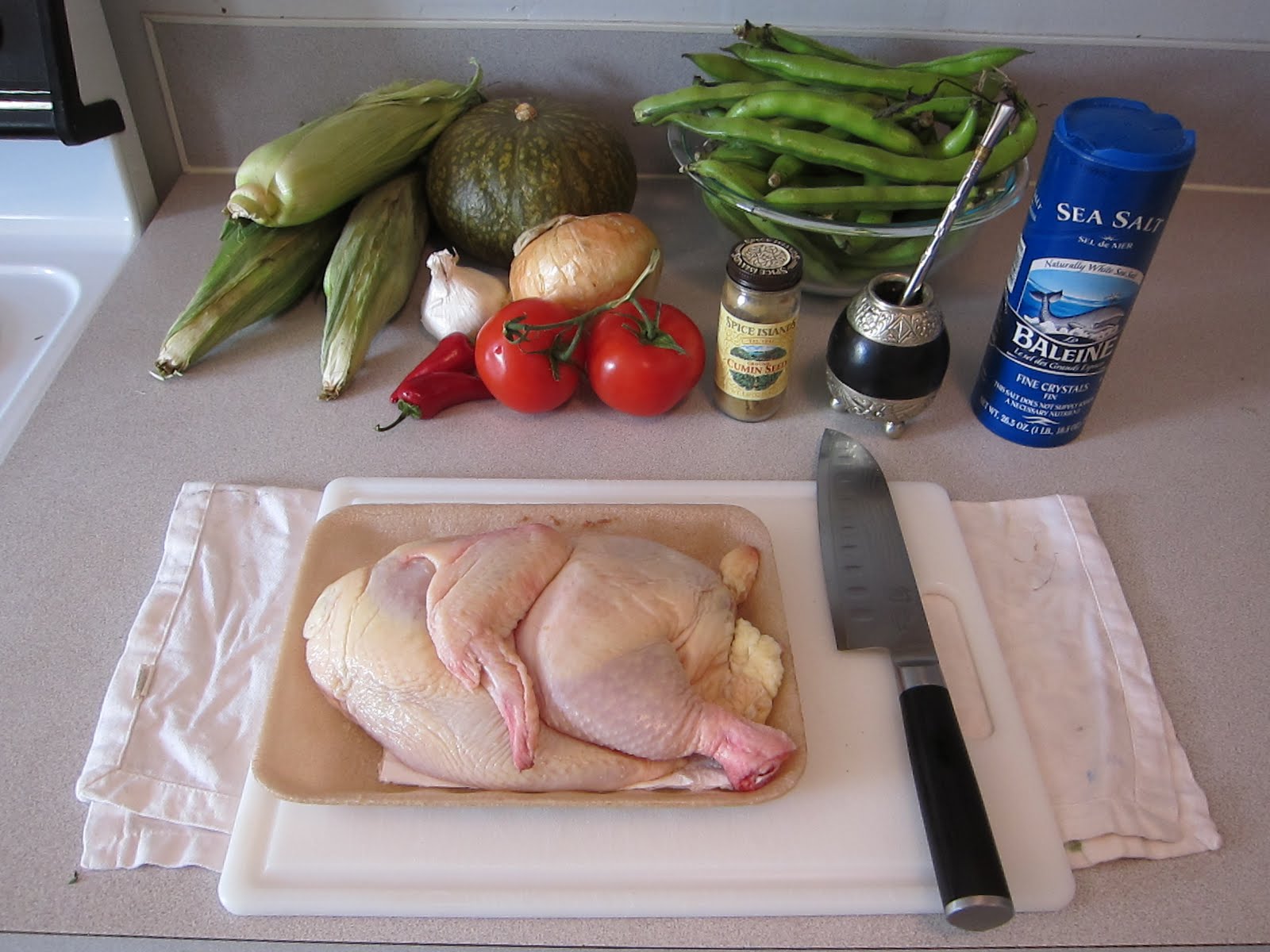
Traditionally, you eat Cebollas Escabeche dipped in salt as a condiment to go with a corn and bean stew called Porotos Granados.  Right now in Seattle the most accessible fresh beans I was able find were fava beans.  I would also use lima or navy beans.  Here is the recipe for about 4 servings:


Porotos Granados:

3 tbsp olive oil
4 coarsely diced garlic cloves
1 medium chopped onion
2 red fresno peppers, seeds removed and diced
1 med chopped tomato
3 ears of corn on the cob, kernels cut off of cob
2 1/2 lbs fava beans pods, removed from pod and removed radicle (the little embryonic stem)
1/2 kobocha squash (or other green skinned, orange flesh winter squash
1 tsp ground cumin
2 tbsp kosher or sea salt
4 pinches of fresh chopped cilantro (or basil) for garnish

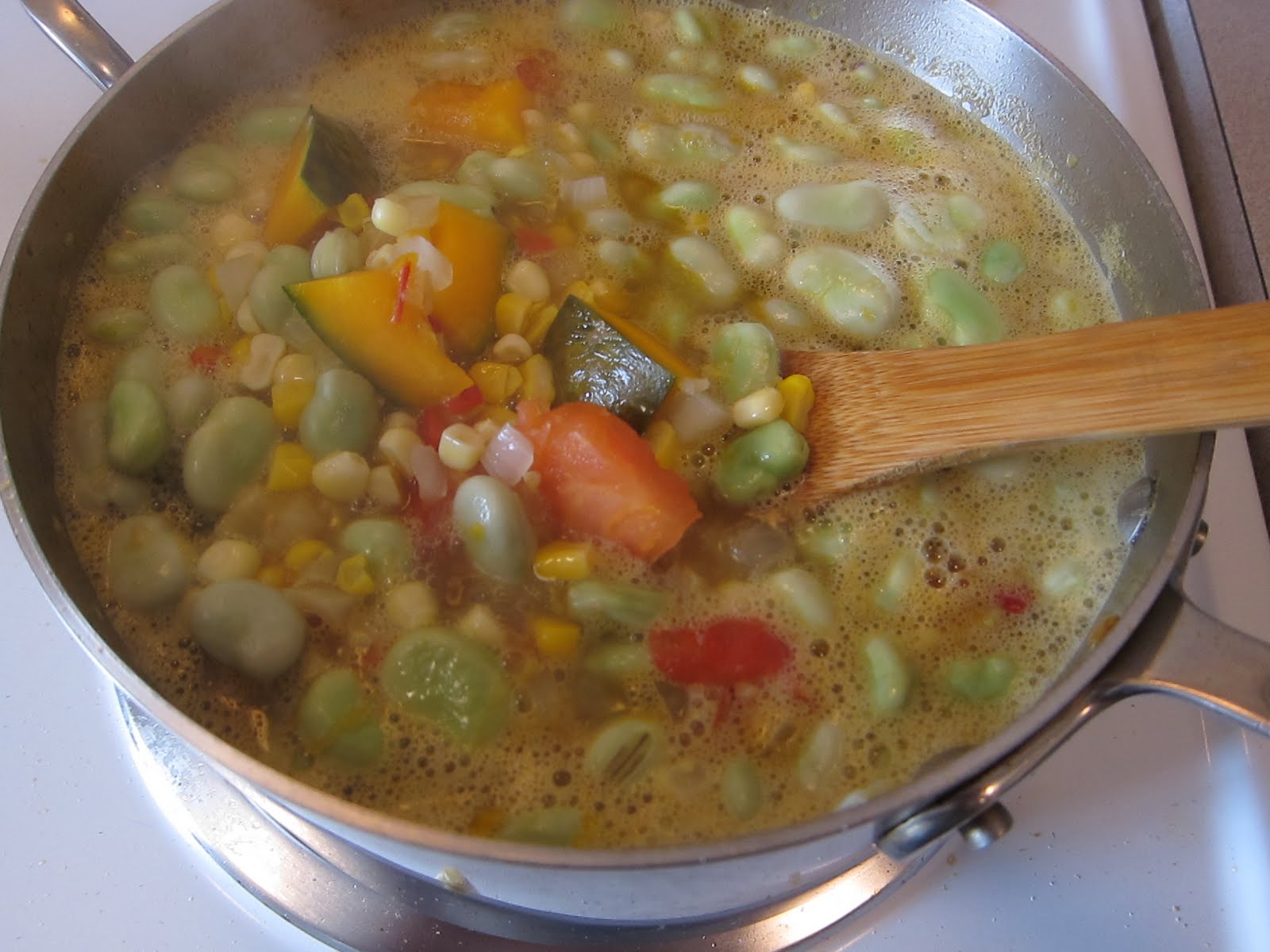
Sweat the onion, garlic, peppers and cumin in olive oil with a little salt over high heat until fragrant.  Add the tomato until it starts to fall apart a little bit.  Add the corn and stir well.  Add the beans and stir well.  Add the squash and stir well.  Cover with boiling water and stir, then lower heat to medium-low.  Stir occasionally until beans  and squash are soft, about 25 min.  Garnish with fresh cilantro.


I served this with 1/2 a broiled chicken.  Just rub the halved chicken with olive oil and liberally apply salt and pepper.  Place in the center rack of the oven on a baking tray, skin side down at 325* F until almost fully cooked.  Then flip and turn on the broiler until the skin gets crispy and a little charred.


All you need now is to put out your Cebollas Escabeche with salt for dipping and a little pebre (hot sauce with cilantro, oilve oil and finely minced garlic) for the chicken.  Now there is a CLASSIC Chilean lunch.  Grab yourself a nice bottle of Chilean Sauvignon Blanc and you might as well be in Chile!


Sunday, May 29, 2011

2009 Burgans Albariño Rias Baixas DO


Appearance:
Clear, transparent, low + intensity, straw color w/ green flints, low + viscosity.

Nose:
Clean, high intensity, citrus: key limes, stone fruit: tart nectarines and plum, tropical fruit: mango, and green apples.  Inorganic earth: chalk, granite and chalkboard.  No noticeable wood.  Lots of aromatics, white flowers, lilies.

Palate:
Clean, med acidity, low alcohol, no tannins, med - body, med + length on tongue, Green apples, plum and tart plum skins, tropical fruit.  Earth: well-structured inorganic minerality: chalk and granite.  No noticeable wood.

As the wine open up and warms up a little, I am wondering if this wine did see a little oak aging.   All of the incredible aromatics of a stainless white wine are there, but it develops that body on the tongue that a little oak can bring out in a white.  With that, there is still very little oak influence on the palate.

This albariño is one of the most balanced I've had, with acidity, lush mouthfeel and incredible aromatics!  Awesome! My new favorite albariño.  This wine is part of the Eric Solomon portfolio.

Wednesday, April 13, 2011

A Trip to the Northern Willamette Valley, Oregon

One of my strongest desires is to learn wines from the "root" to the glass.  Recently I had the opportunity to head to the Willamette Valley to do just that: walk the vineyards, browse the wineries and sample the tasting rooms.

The Willamette Valley is home to some of my favorite Oregon winemakers.  They are known for their earthy Pinots Noirs, and seeing the land on which they grow and the environment they grow within gives you deeper appreciation for that mysterious term: terrior.


This is a view of the Torii Mor vineyard in the Dundee Hills appelation.  At the time of this tour, in early April, many of the vineyards are in the spring pruning phase.  Many of the local vineyards are trimming their vines low using the Guyot Training System (Single Guyot Training pictured above).


To give you an idea of how moist the Northern Willamette valley is, this is a picture of the woods atop the lichen and moss rich hills.  This is the image that comes to mind when I'm picking up those "forest floor" or "organic earth" notes that I love in a deep, complex Pinot Noir.  It makes sense that some of the ambient yeast from the appellation find their way into the winemaking process, leaving their "I was here" mark.


The Torii Mor tasting room Pinot Noir lineup: from left to right they have their Black Label, Deux Verres, Chehalem Mountains Select and the Temperance Hill Vineyard productions.  All of their wines were incredible, displaying unique personalities.  Yet, the Deux Verres was one of my favorites as the signature "Burgundian" style wine from Jacques Tardy, a fifth generation Burgundian winemaker (2008 Deux Verres Info).


Here is a view of the Double Guyot trained vines from the Lange Estate Vineyard in the foreground and a view down into the Willamette Valley in the background.  There is a fairly significant elevation change between the lower parts of the valley and the top of some of the rolling hills, in this case, the Dundee Hills.


Here is another view of the Lange Estate Vineyard.  You can see that the vines are trained using the Double Guyot System (for more on vine training techniques, check out the Vino Diary).


Even more of that "terrior" brain food.  Do you get a nutty, woody earth note on your Dundee Hills pinot?  That could be an excellent call considering this stump (and many more like it) are around and within the vineyards of the Willamette, like the Knudsen Vineyard, growing grapes for the Argyle Winery.


What wine trip is complete without some locally produced and exquisitely prepared food?  This is the pulled-to-order, housemade mozzarella at the Laurelhurst Market Restaurant.


And their charcuterie plate...  The food was incredible and I am very impressed that since my visit, only a week ago, they have changed much of the menu to represent the seasonal ingredients arriving at the "market."

Stay tuned for the tasting notes on the Torii Mor "Deux Verres" Pinot Noir!  Also, I had a recent conversation with a friend about kimchi that reenergized me, so I will get rolling on episode two of "Kimchi (An Ecosystem in a Jar of My Own Creation)."

Saturday, March 26, 2011

Kimchi (An Ecosystem in a Jar of My Own Creation).

My recent attempt at making homemade kimchi has led to an interesting question: how long can it be aged, and why?  What goes on inside a jar of kimchi?  How does preservation work?


First, I must tell you that Kimchi is one of my favorite foods.  The balance of the red pepper spice, the crispy and wilted texture of the cabbage, the umami imparted from the fish sauce or seafood and the fizzy, sour quality resulting from fermentation work perfectly together to create an extremely nutritious and versatile ingredient.  The public praise for kimchi has been tremendous.  Health magazine has called kimchi one of the top 5 healthiest foods. (http://www.health.com/health/article/0,,20410299,00.html)

The way that I personally enjoy food is to understand it at the most basic level, dig deeper, and figure out how it works.  Then, I can knowledgeably and intimately control the quality.  The project that I want to embark on is just this: understand fermentation and how to use it to make kimchi that can satisfy my high standards.  (Who knows, maybe some of what I learn might be applicable to wine.)

Monday, March 21, 2011

2009 "Domaine des Braves" Régnié Beaujolais

Here is a fun one the wine rep. brought into the Dahlia recently -- thanks for the taste RE!  Gaining the designation in 1988, Régnié is the newest Cru Appellation from Beaujolais.  Located just southwest of Morgon, Régnié is the third southernmost of the ten Crus.

2009 "Domaine des Braves" Régnié Beaujolais


Appearance:
Clear, ruby core, pink rim variation.  Medium intensity with slight staining in the legs, low + viscosity.

Nose:
Ripe red fruit: raspberry, cherry, strawberry.  Piercing minerality with slight organic notes of forest floor & mushroom.  Any possible oak notes are lost under the classic, carbonic maceration induced candy notes and sweet herbs.

Palate:
Medium acidity, which was suprisingly low for a Beaujolais.  The ripe red cherry and raspberry fruit becomes more stewed on the palate.  Irony minerality continues, initially offering balance in the mouth and then lingering far beyond the fruit.  Again, any oak influence is impercievable under the wine's other characteristics.  Medium alcohol (13.5%), low tannins and medium body.

Here is a pairing idea... an old desserty snack from the region:  Beaujolais soaked baguette piled high with fresh sliced strawberries!

Sunday, March 13, 2011

2009 "Tenute Cisa Asinari Dei Marchesi" Martinenga Langhe Nebbiolo

Procreating the American trend to consume 85% of wine, the day purchased, here is one that I bought to pair with some truffle infused cheese.

2009 Tenute Cisa Asinari Dei Marchesi Martinenga Langhe Nebbiolo

Appearance:
Clear transparency, garnet core w/ red rim variation, medium (-) intensity w/ very slight staining in the legs, high viscosity.

Nose:
Clean, medium intensity. Tart dark fruit: black currants, pomegranate.  Very organic earthy notes: mushrooms, meat, wet leaves.  Medium oak: more of a sweet, spicy oak note of clove, allspice and vanilla; probably French oak.  For me the prominent aroma notes are the very tart fruit, a meaty/ mushroom depth and a slight vanilla roundness.

Palate:
Dry, high (-) acidity, medium (+) tannins and high alcohol.  Velvety, tart dark fruit: black cherry, black currant, cranberry.  Some of the organic earthy smoked meat and mushroom notes balance out with a slight, wet-stone minerality.  Medium oak on the palate shows itself with a viscous smoky, sweet spice on the tongue and medium oak tannins.  Medium (+) body and sits heavy on the palate.

This wine opened up quite nicely with 45 minutes in the decanter.  The sweeter fruit notes start to peak through the alcohol and the mushroom notes become more smooth without losing the depth it brings to the wine.  This is definitely a food wine with its clean acidity.